|
 |
 |
|
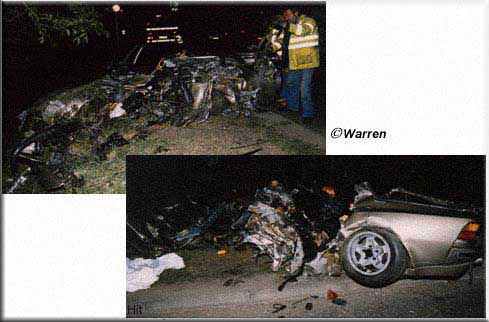
Death of a Motorcycle Rider driver in 1.42 seconds.We all know that a small vehicle generally has
a significant disadvantage during most accident situations. Lack
of mass and compact physical dimensions often account for serious
injuries under conditions where had they been in a larger vehicle
the injuries would not have been so significant.
What about the poor motorcyclist? He operates in a stream of traffic with hazards far more extreme than those confronting the occupants of a small vehicle. He has minimal structural vehicle protection and often comes into direct physical contact with the opposing vehicle. Unlike the motorist, who is enveloped in the protective shield of his passenger compartment, it is the motorcyclist's body that serves as the energy absorbing structure. His fate so often depends on the nature of the impacted structure and the chance orientation of his body as it strikes the vehicle/object. Consider then the effects of a 40mph impact into the side of an emerging car. As the motorcycle contacts the front door of the car the inertia of the front wheel is such that it penetrates 6 inches into the door 15ms (milliseconds), the wheel contacts its engine. The rider starts to slide forwards on the seat. At 25ms the motorcycle frame experiences a deceleration of 39g. The front wheel continues to crush further into the door of the car and it collapses as the engine starts to penetrate the side plane of the car. 63ms the maximum penetration reaches 34 inches. The motorcyclist's knees are buried into the side of the car whilst he is still in a seat posture after sliding forward onto the fuel tank. 55ms his legs sustained a deceleration of 71g. The pivotal action of the knee contact rotates the rider to a standing position bringing his chest forcibly against the 'A' pillar. 80ms, he experiences a deceleration of 109g. The sudden deceleration of the chest flails the head forwards over the top of the car; the helmet strap stretches. 105ms allows the face to strike the roof at 105g. Following this the helmet latch disengages depriving the rider of head protection during any subsequent collision with the car or road surface. The motorcycle and rider fall motionless to the road.
TIME ELAPSED - 1.42 seconds
Just got home after a 2x10 shift.We had a serious fatal accident in my town this afternoon. Can't go into too much detail because the driver will almost certainly be appearing in court but.... Ford Escort containing 5 youths driving into town. Witnesses make certain remarks about the speed of the vehicle (read into that what you will). For some reason the car mounts the pavement and collides into a mother with two children (one in a buggy) the elder child (3 yr old girl) is crushed against a wall and killed outright. She is so badly mangled about the head that we cannot allow father to even see her at the mortuary. Driver breath tested at the hospital resulting in requirement to provide blood sample (no evidential breath test machines at hospital of course). Officers at the hospital report the youths from the car as 'laughing and joking' as relatives of the deceased child and badly injured mother arrive. Back at the station I get a telephone call from an irate gentleman who is extremely unhappy at being made to wait in a traffic jam because the road where the accident occurred is closed for accident investigation purposes. (He knew that a child had been killed). He demanded to know why I hadn't used more of my officers on traffic control. (I'd only got three patrols on duty in the whole area!) Who'd be a copper? Kev (Senior Traffic Officer)
|
|
 |
 |
|
| Copyright 1991 - 2015 Unless specified otherwise, the layout, design and content of this web-site are the copyright material of the The UK SpeedTrap Guide and Steven J Warren. The UK SpeedTrap Guide and Steven J Warren. All rights reserved. The information contained in this website is provided purely for information purposes. Contact & Info - Linking to this Site - Links - Legal Stuff - Permissions Info - Republishing Info - Disclaimer |