SPECS
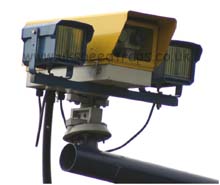
Above: Nottingham Specs
System, Close up of the camera
and IR. lights. This is what you are looking for
So you keep hearing the hype about those new Digital
Automatic Technology Speed Cameras with no film, you hear form
someone its all a hoax, you read about systems that can get
over 4000 offenders in a day on one stretch of road.
I recently did a TV interview on
the 'Trevor McDonald Show' about the impact of these new cameras,
how it would effect me as a driver covering 70,000 miles a year,
my answer.. "They are going to be a nightmare, they will be
abused and fitted everywhere to make a few quid extra in revenue"
So why is it different from a Gatso
Gatso's use film, the film runs out, and at the
moment you have a 1 in 10 chance being caught by a Gatso. An officer
has to go a collect the film, adjust the unit for speed, all adding
up to extra cost they don't want.
SPECS has no film to run out, operators have to
make less journeys to the site and it takes a picture of the front
of the vehicle, allowing them to identify the driver if needed.
It has no flash, and is much harder to spot, Radar detectors don't
detect it. A company called Speedcheck will be operating the systems,
freeing Police officers to catch real criminals, the only good
idea about this whole system.
Gatso cameras promote 'Surfing' the art of slowing
down in the trap zone and speeding up outside the trap zone. A
dangerous pastime, which should be left to the dudes on the beaches
of Cornwall.
SPECS on the other hand overcomes this problem,
by averaging your speed between the two cameras. For example..
Go past the first camera at 70 mph, speed up to 90 mph, slow down
to 70 mph for the second camera and 'hey presto' you have just
averaged 80 mph, but in a real world it won't happen like that.
You may not see the camera at all and just blast
past at 90 mph or you might only see the second one. Most drivers
can't even see a fully liveried Police car until they are about
to get in the boot of it, so how are they going to see a small
camera on a gantry.
Either way if you speed you stand a high chance
of getting a NIP or a warning in the post when this system gets
installed around the UK.
The cost
You may have heard a report that a trial of the
system was done in two locations in the UK, M1 and M20, the M1
units were near Leicester Forest East Services during the roadwork's,
in one day it was reported to have recorded the details of 4300
offenders, if you take that over a year it has the potential of
netting £60 million pounds in fines for the UK Government, yes
and that's from one system!
The combined efforts of all the working Gatso's
in the UK generate less than a third of that.
And the Department of Transport said that "Speed
cameras are an important tool in trying to reduce casualties with
a history of speed related accidents.
So what are the concerns about this system.
Even the former roads minister, Mr. Steven Norris
has expressed concerns about the use of camera systems and he
was the one that introduced Gatso's to the UK.
He expressed concerns that a motorist could lose
their licence after just one trip. "Speed Camera technology
is not about racking up convictions and making allot of ordinary
law abiding motorists very angry, if you pinch people for doing
40 mph in a 30 mph limit in the wrong circumstances all you do
is have a very resentful person on your hands. You don't change
that motorists habits at all. Do it in the right way, you can
save that motorist from themselves"
Even Traffic Officers have reservations about the
system as well, a concern is that this is just a quick and easy
way for the Government to raise a few million pounds, a few million
pounds which won't be ploughed back into road safety.
They don't want to see cameras put willy-nilly
around our roads just to raise cash, but would like to see them
to be used around accident blackspots and high risk areas only.
The systems will be managed by a company called
Speedcheck, based in the London area, the police will dictate
what speed threshold will be set, not Speedcheck who offer the
service to the Police, City and County Councils. They make the
management decisions Speedcheck provide the tool for them to make
informed decisions.
So what can you do to avoid this system?
Well so far there is not a system that you can
buy that will stop the camera getting a picture of your car. If
you have fonts on you number plate that the computer can't work
with and decode, the picture is flagged up and processed by human,
who will be able to read the VRN.
The system is going to be a very hard system to
defeat. But there is one mode of transport that you can travel
past a camera on and that's a motorbike, the system takes a picture
of the front of the vehicle, and we all know motorbikes don't
have front number plates.
So what could be next from a system like this
Well, we know it can read a number plate, so the
system with a little extra programming, if it hasn't been done
all ready, could be used to track vehicles or even terrorists
and criminals. A similar system is in use in the City of London,
the Ring of Steel, Not a bad idea, in fact this is what its best
use could be for. It could also be used to cross reference Tax,
and if they get their act together with the insurance companies,
it could check if a car is insured. The processing of this information
can be done in seconds.
You ask how, well it is very easy to watch a vehicle
travel along a Motorway, you must have seen all those pole mounted
video cameras, well they are not for show, an operator has access
to those cameras and can follow a vehicle very easily. Modern
communications allow the operator to contact a police patrol car
and within minutes the offending vehicle could be pulled over.
I am in favour of equipment being used for this,
uninsured vehicles cost us all money, but for the purpose of just
getting speeding motorists on a nice stretch of Motorway I am
not so sure. Speed Check say they will not target nice stretches
of motorways, but high risk areas such as roadwork's with 40-50mph
limits thus protecting the workforce.
So is the a down side?
The down side of this equipment could be a rise
in banned drivers on the road, and we all know a banned driver
can't get insurance. So what you say, wait till they crash into
your car... you will be counting the cost.
Banned drivers quite often don't care how they
drive and what they drive, stolen and un roadworthy cars.
Quite a few hard working people could become criminals,
unemployed, unable to look after loved ones that are unable to
drive or even walk for that, just for doing what could have been
a safe speed at the time.
So should they give us something in return
if the government insist on using all this state of the art equipment.
Well I am in favour of a new speed limit on the
Motorways, 80-90mph at least, but they should not then allow the
10% rule, and should enforce the speed limit with the new systems
such as SPECS. In bad weather, like rain then the limit should
be lowered, as they do in France.
The M25 has a great example of control of a speed
limit, they spent millions fitting the gantries and variable speed
limit signs, and good use of this in the correct conditions could
allow drivers to travel at 80-90mph.
We all know when we are on that stretch of the
Motorway speeding is not a wise choice, with all the Gatso's looking
at you.
Okay you say, some will still speed, but you will
always get the die hard, that don't play by the rules, lets face
it they won't last long though with the new systems.
With the money they will make in fines from cameras,
why cant they invest it back into variable speed limits, safer
roads and training. A recent report says they might.
A speed limit increase is justifiable, most police
officers won't stop you for 80mph on a Motorway, in safe conditions.
Modern cars are safer, so with the addition of better training
and a better driving test, which includes the Motorway, why not.
I am not a perfect driver I have had convictions
for speeding, all I must say on motorways, I don't speed on built
up roads.
I was a victim of being hit by a car at 40mph,
he just clipped me as I was walking home one night. I spent three
weeks in hospital being put back together and 6 months in plaster
after that, it did effect me, and reduced my speed, but not on
a Motorway, where there are not so many hazards, I do speed. Okay
maybe I should not. Protecting the workforce on a Motorway with
cameras is a good idea.
Truckers send me many an e-mail saying that being
restricted to 56mph on a Motorway is bad news, all say that the
journey gets very boring and often after time they don't even
concentrate on there driving. I even heard a figure that after
speed limiters were fitted accidents went up 24%.
Could that happen to car drivers when we are all
to scared to drive over 70mph
I tried driving to Glasgow form the midlands one day at 65-70mph,
it got so boring that I could not even remember some parts of
the trip. The same trip home, I went over the limit, my concentration
and awareness was much higher.
SPECS
System
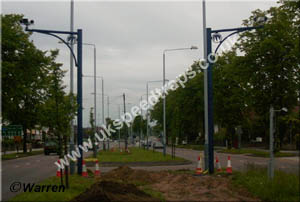 Above: Nottingham Specs System, Two poles with one camera on each Above: Nottingham Specs System, Two poles with one camera on each
looking at each site of the road.
|
Above: Nottingham Specs
System, Close up of the camera and IR. lights. |
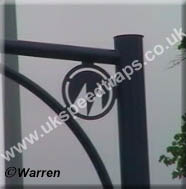
Above: Look for the logo...
|
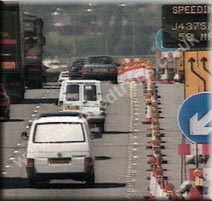 Above: VMS Optional Equipment
(Sign can be seen in top right of photograph)
Above: VMS Optional Equipment
(Sign can be seen in top right of photograph)
If the vehicle is found to be breaking the speed limit,
its registration number,
the speed at which it is travelling and a warning to slow
down is flashed up on a large display
positioned shortly after the second camera enabling the
driver to reduce his or her speed accordingly. |
Trials of SPECS evaluated by Kent Police Force at
Junction 8 of the M20 and the Leicester Constabulary on the M1
at Leicester Forest East led to a reduction in the number of speeding
vehicles of approximately 30%. Although no vehicles were prosecuted
during testing. On April 1st 1999 Home Office Type Approval was
granted for the SVDD technology SPECS uses which means that drivers
who break the speed limit in future can now be liable to prosecution.
This is enforceable in court with evidence from the discs in the
roadside cabinets.
This could be one of the most dangerous systems
out there to constant speeders. Being quite small and hard to
spot in its smallest form. Undetectable by radar detectors. It
will soon prove it's self. However they could also be mounted
on high visibility poles creating speed controlled zones.
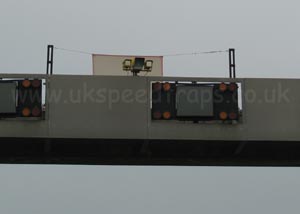 Another way of mounting and using SPECS.
|
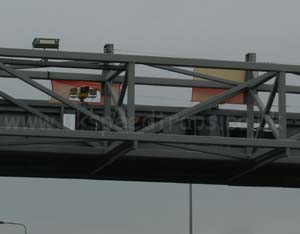 This system is on the M6 in roadwork's
 |
How does it work?
Using a pair of Video cameras.
The first is positioned at a fixed point on the road a second
camera is positioned 200m minimum further along the carriageway.
They are able to setup a network of these video cameras as well.
As vehicles pass between the cameras they are digitally recorded.
The time which it takes the vehicle to travel between both points
is used to calculate the average speed of the vehicle.
If the vehicle is speeding, the cameras record
the registration plate and capture a colour image of the front
of the car, time, location and average speed travelling between
both locations, they use the front of the car not so they can
identify the driver the face is not recognisable, this is because
the front plate stays cleaner.
This information is instantly recorded on discs
in roadside cabinets near the of the road functioning 24 hours
a day which can be collected by the police or Speed Check staff.
As an option it also can also be relayed to a control office via
a optic fibre cable. Linked to the DVLA or PNC computers which
can provide driver details that are used to track down offenders.
All this can be done in less than 4 seconds
Inside the box on the side of the Motorway are
ANPR processing units for each camera and an optional connection
to send the evidence to a central processing and data storage
unit.
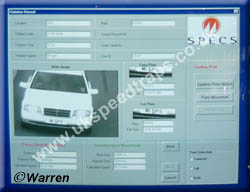
Above: Lets hope the bugs in
Windows
don't upset the system...
An interesting point is... Automatic ticket processing
could be carried out by specially trained staff. This means
that police forces will not have to handle the paperwork freeing
up more police time. The digital operation of SPECS also enables
connection to other monitoring and control systems to provide
comprehensive management data creating a very powerful speed
management tool.
Flaws in the system are slowly becoming apparent,
the main one being that the video image does not show the driver
clearly enough, Article Six of the European Convention on Human
Rights comes to mind. Square number plates are reported to be
unreadable due to the software requiring the text all on one line
this however is unconfirmed. It also appears that if a plate is
unreadable it is not flagged up again unconfirmed. The front plate
is read because it is the one that tends to stay cleaner, sounds
like dirty plates give it a problem.
SPECS
System Press Launch.
On the 28th July the official launch of the SPECS
system was made, and I managed to get an invite to go along.
At the meeting was a line up of people,
Stewart Thompson - Nottingham CC Road Safety
Service Manager.
Cllr Brian Parbutt - Nottingham CC.
Sabine Marlow - Mother of Christopher who died 20 months ago.
Jacqui Elliott - Speed Check Services Ltd
Gwyn Drake - Divisional Director Network Customer Services Midland
Region Highways Agency
Steve Green - Chief Constable Nottingham Police.
They all gave a three minute speech telling us
how they have spent £300,000 on this new state of the art speedtrap
system, how it was going to reduce traffic speed in Nottingham,
save an estimated 78 injury accidents in its first two years giving
a saving of £5.2 million to the community.
They told us that this is a major link road and
in the last three years 362 injury accidents have been reported.
The accidents were all the result of speed.
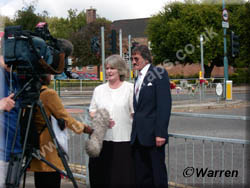
Above: Sabine Marlow Mother if
Christopher
who was killed in this spot.
They also had the mandatory story to get the point
across, Sabine Marlow a mother of a boy that was killed over 20 months ago talked again about how speed was to blame,
she was pleased to be here to help on the launch of the new cameras. Her plea was "Cut down your speed"
Gwyn Drake said the whole campaign has been dedicated
to the memory of Christopher the twelve-year-old boy that was
killed by a speeding driver... but no facts of the case were given.
Speedcheck's Jacqui Ellott, said by using
the system Nottingham CC aim to reduce road casualties by 1/3
in the 2 year trial. "We are not out to get the motorist, we
want to encourage motorist to think about road safety, by
reducing you speed you could help in saving lives"
2.5 kilometres of road is covered the moment
using 6 cameras and over the next few years that will increase
to 18 pairs of cameras covering 8 kilometres
Fines they say will be used to directly fund more
safety improvements and finance the cameras.
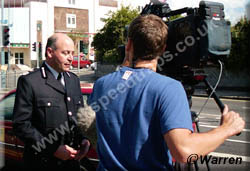
Above: Chief Constable Steve Green
Chief Constable Steve Green, talked about
operation CARE this is a major operation to reduce casualties
on Nottingham's roads, telling us that the public in Nottingham
said that outside burglary, speed is one of there major concerns. "Speeding is a major cause of accidents, Nottingham police
believe that this camera scheme will make will make a big impact
in causality reduction, this is not about making money, this is
about saving lives."
We were then given the opportunity to ask questions,
no one was asked.
We were taken on a bus tour to see the camera sites, and given
the opportunity to ask questions at a pre determined site. The
site was where 20 months ago Sabine Marlow lost here son, fresh
flowers were all over one of the barriers more photo shots for
the press. At this point I did ask a few questions, and guess
what, none of the people I asked would give me an answer and it
was not because I was rude it was because they did not like the
questions. This let them down as far as I was concerned.
One question was, "We all have it drummed into
us that speed kills, do you mean inappropriate speed or all speeding?"
The general idea I got from the answers was all speeding but they
would directly say...
Another question was to see how serious they were
about saving lives.. and this one got them all. "You say at
35mph you are twice as likely to kill someone than at 30 mph,
so are you going to enforce the 30 mph limit by setting the cameras
at 31mph and thus saving more lives or are you still going to
allow the 10% that everyone is used to and not save as many lives?" no one liked the question, all that were asked did a very good
job of beating about the bush. Now don't get me wrong here I would
hate to see 31mph enforced in a 30mph, even more so because of
the inaccuracy of speedometers, but is a thought provoking question.
Is it going to save lives, reduce accidents, save
money, it could do. I do believe however they are doing it wrong,
they should tell people the speed they set the system at and have
more signs. If they want to save lives they need to slow drivers
down and with the current way they do things it is not going to
work. Everyone knows that a gatso in a 30mph limit is not set
at 30mph its often set much higher, usually above 35mph and that's
why I asked the second question.
I don't believe that are taking this as serious
as they could, which leads me to believe it is more for political
points and revenue, than road safety.
We will have to wait now to see if it does what
they say it will...
UPDATE:
The Nottingham System makes a Loss but the traffic
has slowed down. So the money making part that Nottingham CC always
denied is not working for them however the road speed has slowed
on the stretches where SPECS has been installed. |