VASCAR units deactivate automatically after 7 days which means the
operators have recalibrate them, this however is not the case
and most officers test the unit at the start of each shift.
Common places for the use of VASCAR is on motorways, in which
the police car will wait just out of sight on a slip road, and
time the vehicle between two points, usually the white painted
square or round markings on the road, but any fixed points can
be used, that the distance between them is known. They can also
use it when they are following you or when you are following
them.
The minimum distance the police are allowed to
is 0.125 miles - one-eighth of a mile. Under exceptional circumstances,
they're allowed to go down to 0.07 miles but only in pre-fed
or dial-in distance modes where the start and end points are
not shadows. Police helicopters and Motorbikes can take the
same measurements
Those white squares and circles that are painted
on the road are used for VASCAR systems. They are set distances
apart, and quite often are quite visible to the police from
a great distance, they could be parked up to half a mile away
and still get a speed reading of an offending vehicle. But remember
any fixed point can be used, such as a lamppost.
This is potentially the easiest one to throw in
court, but can be a hard job to do. It is open to human error
on the timing positions and the pressing of the button.
Just a little note
sent to me from a Traffic Officer."If
Vascar is used correctly the margin of error is presumed to
be the same at either end of the check.
The Home Office allows a percentage of error for the overall
check and this built into the operating procedure. Each and
every police officer undergoes an intensive training course
to establish their margin of error. If it falls within the guide
lines then it is "acceptable". So don't go using the info
below unless you can prove your case without doubt."
Extract from
USA Law Paper
VASCAR (Visual Average Speed
Computer and Recorder) is really a stopwatch coupled with a
calculator. Once a distance is entered, the operator pushes
a button to start then stop the stopwatch. VASCAR displays the
speed calculated from the distance entered and the time measured.
Thus, a VASCAR measurement
depends on human input. Therefore, in order to make a VASCAR
measurement as accurate as possible, the observer's/operator's
reaction time must be as short as possible. (Reaction time is
defined as "the time interval between an input signal (physiological)
or a stimulus (psycho physiological) and the response elicited
by the signal.)
What is considered "normal"
human reaction time? First, let's take a look at the best: Drag
racers. Average reaction time of (Top Fuel) drag racers at the
1997 U.S. Nationals was 0.124 ± 0.082 second. Imagine that our
cop running VASCAR is a super cop, with drag racer like reaction
times: What kind of error is introduced into the VASCAR speed
measurement by a reaction time of 0.124 second? With the numbers
testified to by our cop:
Distance ÷ Real time
± Error = Measured Speed 100 ÷ 1.54 + 0.124= 60.096 feet/second (40.97 mph)
or
100 ÷ 1.54 - 0.124= 70.621 feet/second (48.15 mph)
Depending on whether the cop was 0.124 second too quick or too
late.
The calculation above takes into consideration only one opportunity
for error.
However, the cop must
not only start the VASCAR's stopwatch, but he also must stop
it. Thus, he can introduce the error twice:
100 ÷ 1.54 + 0.248= 55.928 feet/second (38.13 mph)
or
100 ÷ 1.54 - 0.248= 77.399 feet/second (52.77 mph)
Looks like we are getting some error margin here: it is almost
15 mph. But wait a minute: the cop alleged that he clocked our
man 66 mph (96.8 feet/second).
If true, the elapsed time
over 100 feet distance was 1.033 second. The error in speed
reading introduced by human reaction time becomes even more
severe:
100 ÷ 1.033 + 0.248= 78.064 feet/second (53.225 mph)
or
100 ÷ 1.033 - 0.248= 127.388 feet/second (86.855 mph)
WOW! An error margin of
more than 33 mph! And remember we assumed that the super cop
in this example has reaction times similar to a drag racer!
Imagine if the cop is only
human: Average adults show reaction times around 0.3 second
-- it's not even worthwhile to do the calculation. Obviously,
we can no longer talk about accuracy and VASCAR in the same
sentence. One can conclude that using VASCAR over a 100-foot
distance cannot yield any accurate speed reading for the speeds
alleged in our man's case. We come to this conclusion even before
considering other sources of error, such as visual distortion
introduced by the parallax effect.
A little note though
UK Police don't take a reading over this distance, theirs is
greater, so the reading could be more accurate.






 Visual
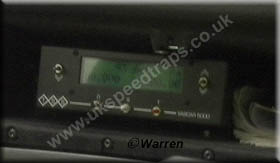
Average Speed Computer And Recorder. This system is a timing computer, it has to be set for the distance
first, between a bridge and a marker post for example and then
the police officer presses a button at the start of the timed
position when the vehicle passes, the bridge. When the vehicle
passes the second position, the marker post, he then presses
the button again, this will then give an instant average speed
between two points.
Visual
Average Speed Computer And Recorder. This system is a timing computer, it has to be set for the distance
first, between a bridge and a marker post for example and then
the police officer presses a button at the start of the timed
position when the vehicle passes, the bridge. When the vehicle
passes the second position, the marker post, he then presses
the button again, this will then give an instant average speed
between two points.